Jenny Yurshansky
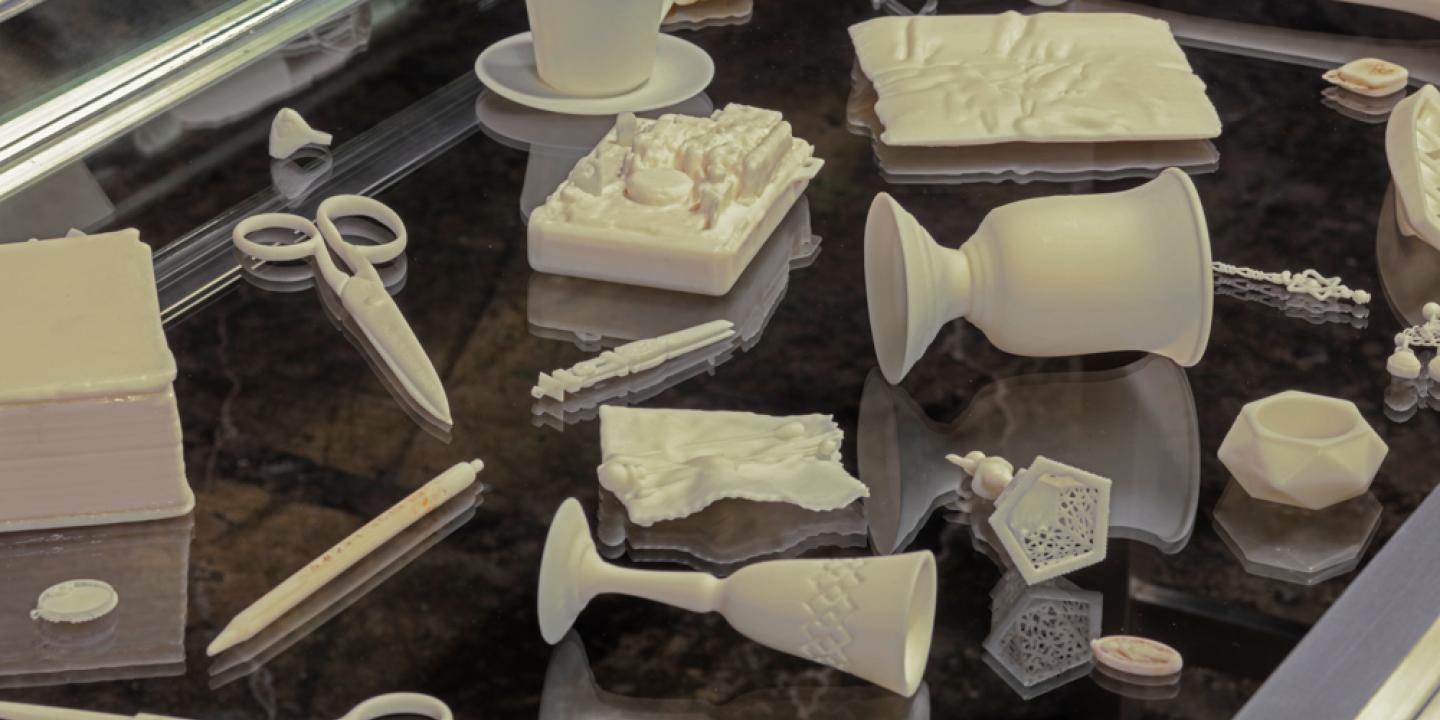
Rinsing the Bones (Reliquary) (detail), 2023
3D resin prints, alcohol ink, glass, mirrors, aluminum, steel, and shadows
35 x 70 x 27 inches
This special workshop offers you the chance to have your stories and object replicas incorporated into Jenny Yurshansky's upcoming exhibition, What We Carry, opening October 2026 at the Skirball.
This is a past program
This program took place on
Sunday, February 22, 2026
About the Workshop
Jenny Yurshansky’s upcoming Skirball exhibition, What We Carry, explores the impacts of immigration and displacement—honoring what has been carried across generations, acknowledging what has been lost, and finding points of connection in each other’s stories. The exhibition invites audience participation in creating a collection of immigration narratives—chronicling events, cataloging treasured objects, and examining how history is assembled and retold.
For this workshop, Yurshansky invites participants to bring a family keepsake—a small object representing part of their family's migration. The artist will meet with each participant and interview them about what this object means and why it has been kept, recording their story on audio. While the artist records the interview, her assistant will use a 3D scanner to create a digital model of the participant’s object, which the artist will use to 3D-print a replica that will be displayed in the exhibition. The participant’s audio recording of their story will be available for visitors to listen to on records made out of X-ray film, reminiscent of Soviet “bone” records.
Participants’ stories and replicas of their objects will be incorporated into Jenny Yurshansky’s upcoming exhibition at the Skirball opening October 2026.
Know before you go:
• Participation is between the individual person and the artist; this workshop is not a group activity.
• Participation time varies from 15–20 minutes.
• Your object should be something you can hold in your hand, no bigger than 7 inches long or wide and 2 inches high or deep.
• Final edited recordings will be a maximum of 12 minutes in length. If the initial recording is longer than that, it will be edited for length.
• A highly specialized spray created for the 3D scanning industry will be used if the object has any reflective surface. Please note that it leaves no trace and will disappear within 4 hours if you allow your object to remain exposed to air so it can fully evaporate.
• Participants can choose to be acknowledged in the project or remain anonymous.
About Jenny Yurshansky
Jenny Yurshansky is a Los Angeles based artist whose experience of being born stateless to Soviet refugees led her to research the suppressed pain, loss, and stress shared by displaced people and their offspring. From her own experience and what others have shared with her, she has learned that it is not unusual for refugees to avoid, forget, or suppress discussions about the past. The unexplained gaps in family stories indicate that a painful history is most likely the cause for what is being left unsaid. Yurshansky hopes to provide displaced persons and their descendants with a safe space to honor lost narrative threads, have difficult conversations, discover shared histories, and offer empathy so we can see the patterns we share even when our accounts have different trajectories.
Yurshansky received her MFA in Visual Art from University of California, Irvine (2010) and was a post-grad in Critical Studies at the Malmö Art Academy. Her solo exhibitions include Rinsing the Bones, 18th Street Arts Center (2023); There Were No Roses There, American Jewish University (2022); Blacklisted: A Planted Allegory, Harvard-Westlake School in Los Angeles (2020); Emerging Artist Series, Pitzer College Art Galleries (2015) and the Stockholm Royal Institute of Art (2015). Recent projects include We are all guests here., a commission at Bridge Projects (2021); and a series of over forty virtual workshops during COVID hosted on behalf of American Jewish University, Fulcrum Arts, Museum of Contemporary Art Los Angeles, and Pitzer College, among other institutions offering the public a way to maintain a sense of community, connect to social justice issues, and participate in somatic activities that focused on breath and landscape.
